 Light Is Optional.
Home › Thermal Imaging › TS Series
Pick the core by resolution (256×192 / 384×288 / 640×512 VOx), the lens by mission (19 / 25 / 35 / 50mm F1.0) — all on the same 0.39″ OLED platform with Picatinny mount and optional laser rangefinding.
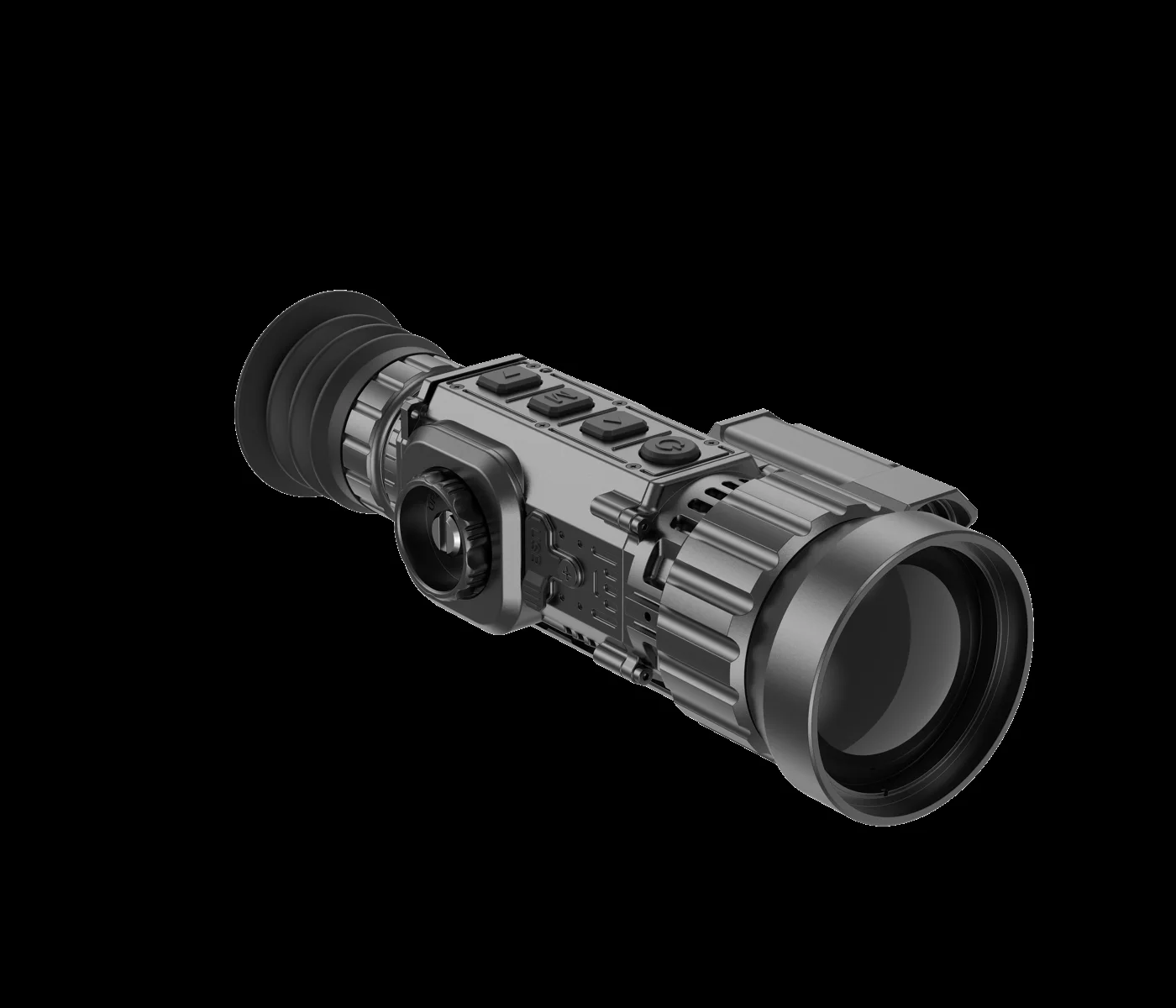
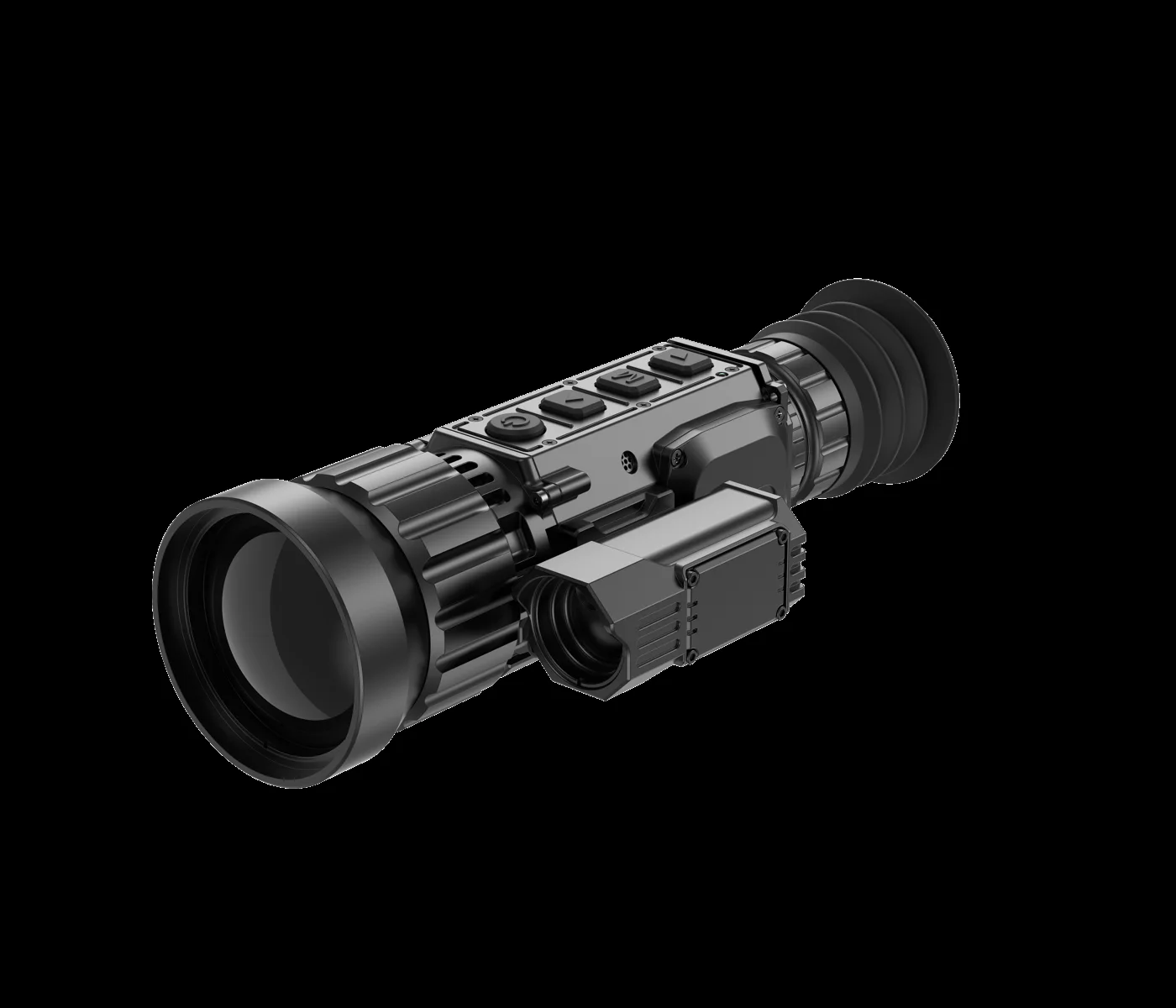
| TS2 | TS3 | TS6 | |
| Detector | |||
| Detector type | Vanadium oxide uncooled infrared focal plane (VOx) | ||
| Resolution | 256×192 | 384×288 | 640×512 |
| Spectral band | 8μm ~ 14μm | ||
| Pixel pitch | 12μm | ||
| NETD | ≤40mK @25°C, @F1.0 | ||
| Frame rate | 50Hz | ||
| Lens & field of view | |||
| Infrared lens | 19mm F1 (25mm F1 optional) | 35mm F1 (25mm / 50mm F1 optional) | 35mm F1 (25mm / 50mm F1 optional) |
| Field of view & magnification | 9.2°×6.9° (19mm) · 2.7× 7.5°×5.3° (25mm) · 3.6× | 10.5°×7.9° (25mm) · 2.4× 7.5°×5.6° (35mm) · 3.4× 5.3°×3.9° (50mm) · 4.8× | 12.5°×10° (35mm) · 2.0× 8.8°×7° (50mm) · 2.8× |
| Display & image | |||
| Display | Monocular 0.39″ color OLED, 1024×768 | ||
| Diopter adjustment | −8 ~ +3 | ||
| Exit pupil | 38mm | ||
| Image modes | Black hot / white hot / pseudo color | ||
| Digital zoom | 1× / 2× / 3× / 4× | ||
| Picture-in-picture | TS3 / TS6 (2× magnifier window) — not on TS2 | ||
| Power & connectivity | |||
| Battery | 4 × rechargeable 16340 (CR123A-size) Li-ion — 8 cells in the package | ||
| Runtime | ≥4h | ||
| Storage | 64G, expandable to 512GB | ||
| Sealed port | Type-C — power, analog video output, media management | ||
| Wi-Fi | Image transfer (Android devices) | ||
| Menu languages | Simplified Chinese / English | ||
| Mechanical & environmental | |||
| Mount | Picatinny rail | ||
| Shock | ≤1000g | ||
| Weight | ≤650g (with battery) | ||
| Size (L×W×H) | ≤260mm×60mm×80mm (with mount) | ||
| Working temperature | −20°C ~ +55°C | ||
| Storage temperature | −40°C ~ +70°C | ||
| Laser rangefinder | Optional, up to 1.5 km — single & continuous ranging; ballistic calculation (with LRF) | ||
Per the factory user manual — upright-adult and mid-truck reference targets by lens. Detection = target presence; recognition = target classification.
| Target | Mode | 19mm | 25mm | 35mm | 50mm |
| Upright adult | Detection | 800m | 1000m | 1450m | 2000m |
| Recognition | 400m | 500m | 730m | 1000m | |
| Mid truck | Detection | 1800m | 2400m | 3400m | 4800m |
| Recognition | 900m | 1200m | 1700m | 2400m |
Scene demonstrations from the field — how targets render through the TS series palettes: rainbow for contrast against brush, white-hot for maximum detail on cool backgrounds.
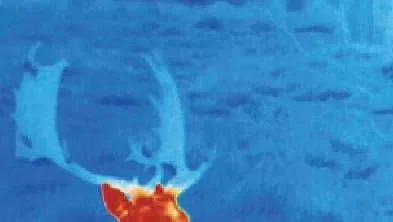
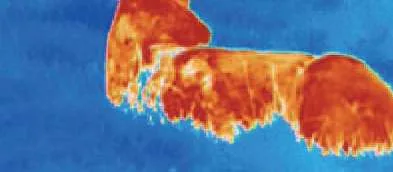
Recorded through the optics — the TS6 · 35mm clip carries the live compass OSD (azimuth / pitch / roll); the four TS3 clips are native 384×288 detector output. Click to play — nothing loads until you do.
TS6 · 35mm — people on a trail, live azimuth / pitch / roll OSD · 31 s
From the factory user manual — the hunting workflow, in three steps.
Freeze zeroing, five profiles. Zero at up to five saved distances (profiles A–E, switchable from the quick menu). The freeze method holds the image while you walk the reticle to the point of impact on X/Y, then save — a confirmation shot verifies. Custom zero distances are set per profile.
Ballistic calculation. With the laser rangefinder ordered, three ballistic profiles compute holdover from range plus environment: altitude, barometric pressure, temperature, crosswind, and coordinates — shown as a ballistic point at screen center. Muzzle velocity and sight-height offsets are configurable per profile.
Reticles. Six reticle types in five colors (yellow / black / white / green / red); pixel-defect correction and meters/yards units in settings.
Same detector, same housing — the lens decides the hunt. The 35mm configuration is the field-of-view choice: a wider picture for woodland, field edges and moving targets at practical ranges, where finding the animal in frame matters more than reach. The 50mm configuration trades that width for magnification and detection range — the open-ground and long-clearing choice. A working rule: if most of your glassing happens inside a few hundred metres, take the 35mm; if you scan open terrain end to end, take the 50mm configuration. Both ship with the per-lens detection chart printed on their pages, so the comparison is on paper, not on promises.
Which model should I choose — TS2, TS3 or TS6?
TS2 (256×192) covers close-range scouting at the entry price; TS3 (384×288) is the mid tier; TS6 (640×512) delivers the sharpest image and the longest reach. All share the same display, optics family and housing.
Is the laser rangefinder built in?
The laser rangefinder is an optional feature — add it when ordering if you need in-view ranging. Detection and identification charts per lens are published above.
Which lens should I pick?
19mm for wide close-range scanning; 25mm as the balanced option; 35mm as the standard all-rounder; 50mm for maximum reach. Field of view for each combination is listed in the specification table.
What battery does it use?
Four rechargeable 16340 (CR123A-size) lithium cells, ≥4h continuous operation — and the package
includes eight cells, so a charged set is always ready. The sealed Type-C port also supports
external power, CVBS video output and media management.
Why does range drop in rain, fog or snow?
Weather and lighting degrade any thermal and rangefinding performance — that is physics, not a defect.
In freezing conditions scenes lose heat contrast and image quality drops; both are documented
characteristics of thermal imaging in the user manual, and both recover as conditions change.
How does the TS series mount?
Yes — the Picatinny rail is the standard installation interface, rated ≤1000g shock.
MOQ and OEM/ODM?
Contact Anthony C. — [email protected] or via WhatsApp. Standard RFQs answered within 4 working hours.
Request TS Series Quote TS6 · 50mm Configuration → All Thermal Products